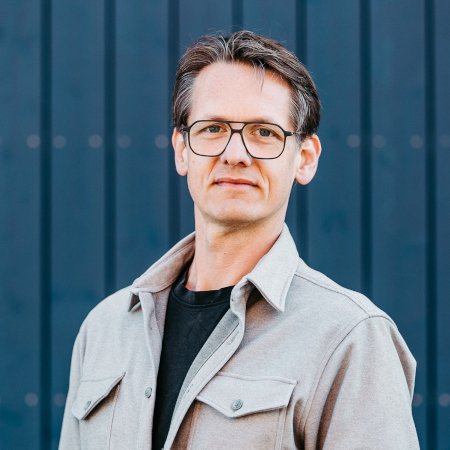
Welcome
Benedikt Gräler completed his Diploma in Mathematics in 2009 and earned his PhD in Geoinformatics in 2014. He conducted his research at the Institute for Geoinformatics in the field of spatial statistics; his developments and findings are collected in his dissertation Developing Spatio-Temporal Copulas.
In January 2016, he joined the Institute of Hydrology, Water Resources Management and Environmental Engineering at Ruhr-University Bochum as a research associate and contributed to the SFB 823 “Statistical modelling of nonlinear dynamic processes”. Since May 2017, he has worked at 52°North Spatial Information Research GmbH as a research associate and consultant leading the Spatio-Temporal Data Science Lab. In May 2021, Benedikt became one of the managing directors of 52°North. He is responsible for the research pursued at 52°North and keeps close contact with universities and associated research partners. Together with con terra and the University of Münster, he initiated the Spatial AI Nexus Münster with 52°North as founding member, a transfer network that brings applied spatial AI research into practice for public authorities, companies and international organisations.
Beyond 52°North, Benedikt serves as Vice-President of EUROGI, the European umbrella organisation for geographic information, and as Europe delegate of the Deutscher Dachverband für Geoinformation (DDGI).
Research
At 52°North, Benedikt researches Information Systems for spatial and spatio-temporal data integrating statistical methods, machine learning and GeoAI applications. This is accompanied by research on agent interactions with information systems.
Benedikt’s focus in mathematical research has been on copulas and he extended the concept to the spatial and spatio-temporal domain. This includes modelling spatio-temporal random fields, trajectory data of various kinds, as well as identifying and modelling extreme events in space and time. Please take a look at his publications for a detailed list of recent professional activities. With the help of shiny, he made different copula families interactively accessible in his copulatheque.
Software
In parallel to his research, Benedikt develops the R package sfcopula, which models spatial and spatio-temporal random fields with vine copulas. It is the successor of spcopula and builds on sf and stars instead of the former sp and spacetime packages. Besides his own packages, he contributes to a set of further R packages related to copulas as well as spatial and spatio-temporal data representation and analysis, such as gstat, spacetime, VineCopula and trajectories. A detailed overview can be found on his GitHub profile.